2025 Desktop 3D Printing —— Functional Segmentation Between FDM and Resin in Small Production Environments
Posted July 2, 2026 by ryan12138
In 2025, desktop 3D printing is moving from tech competition to application-based division. FDM handles functional parts, while resin focuses on precision and surface quality, forming a complementary workflow in small production.
Desktop 3D printing in 2025 is no longer defined by rapid growth alone but by increasing functional specialization across use cases.
Rather than competing technologies, FDM and resin systems are increasingly forming a complementary production stack within small manufacturing environments, particularly those involved in prototyping, custom fabrication, and low-volume production.
This shift reflects a broader trend toward application-driven manufacturing decisions at the desktop scale.
Functional separation replaces technology competition
Historically, FDM and resin printing were often compared as competing technologies. However, in current small business environments, the distinction is becoming less competitive and more operational.
FDM systems are primarily deployed for structural and functional output, including jigs, fixtures, housings, and early-stage prototypes.
Resin systems, in contrast, are increasingly reserved for applications requiring dimensional precision and surface fidelity, particularly in visual prototyping and detailed component fabrication.
Rather than replacing one another, both technologies are now routinely deployed in parallel within the same workflow.
Material and process selection is the primary decision factor
In practice, the choice between FDM and resin printing is increasingly determined by material behavior and post-processing requirements rather than machine capability alone.
FDM materials such as PLA and PETG continue to dominate cost-sensitive and functional applications, while photopolymer resins remain preferred for high-detail output despite higher operational complexity.
At this stage of market maturity, material selection is often the defining constraint in desktop additive manufacturing workflows.
Material selection frameworks are commonly used for comparing filament and resin workflows.
Hybrid adoption in small production environments
An increasing number of small production teams are now operating hybrid setups combining both FDM and resin systems.
This approach allows users to allocate tasks based on output requirements rather than technology limitations:
· FDM for functional validation and structural components
· Resin for presentation models and precision parts
This separation of roles improves both production efficiency and cost control, particularly in environments where rapid iteration is required.
Cost structure remains secondary to application fit
While cost remains a factor in system selection, it is increasingly secondary to application requirements.
FDM maintains advantages in material cost and operational simplicity, while resin systems justify higher cost through improved surface quality and precision.
The resulting trade-off is not purely economic, but functional.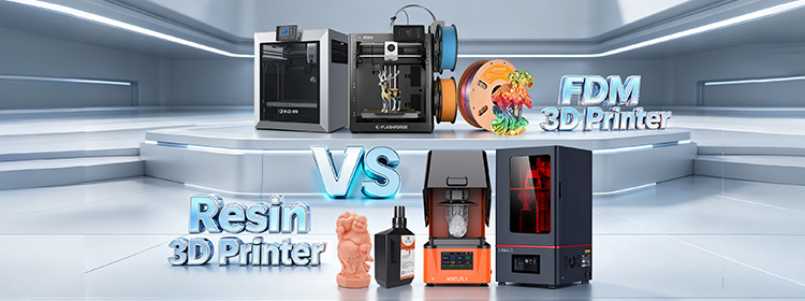
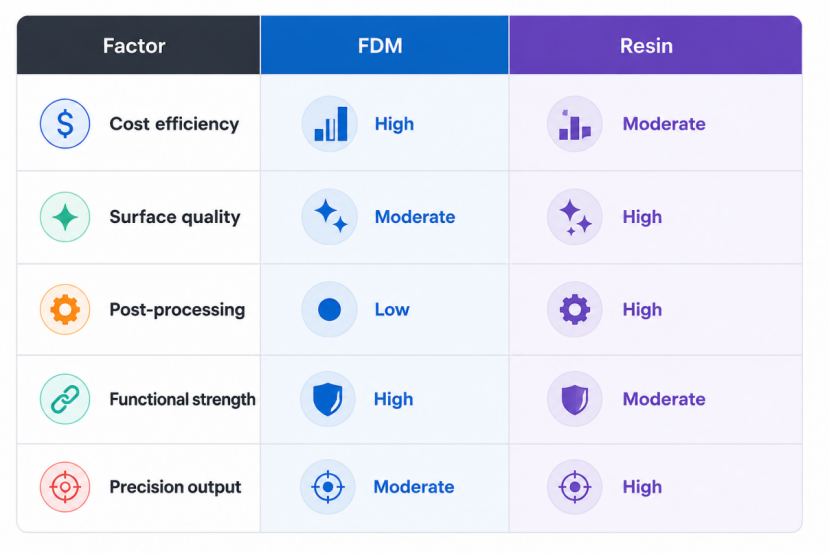
Desktop printer selection is generally evaluated based on application suitability rather than isolated hardware specifications.
Conclusion
The evolution of desktop 3D printing in 2025 reflects a structural shift rather than a technological one.
Instead of competing paradigms, FDM and resin systems are increasingly forming a distributed production model where each technology serves clearly defined functional roles.
As a result, small business adoption is becoming less about choosing the “best” printer and more about designing effective hybrid workflows around material and application constraints.
To support this trend, GearVita provides a range of desktop FDM printers, resin printers, and printing materials for makers and small businesses.


| Contact Email | [email protected] |
| Issued By | GearVita |
| Website | Best 3D Printing Store,3D Printers,Filaments & Resins | GearVita |
| Business Address | 3045 Edinger Ave, Tustin, CA 92780, USA |
| Country | United States |
| Categories | Engineering , Manufacturing , Technology |
| Tags | technology , engineering , manufacturing , industry , research |
| Last Updated | July 10, 2026 |